
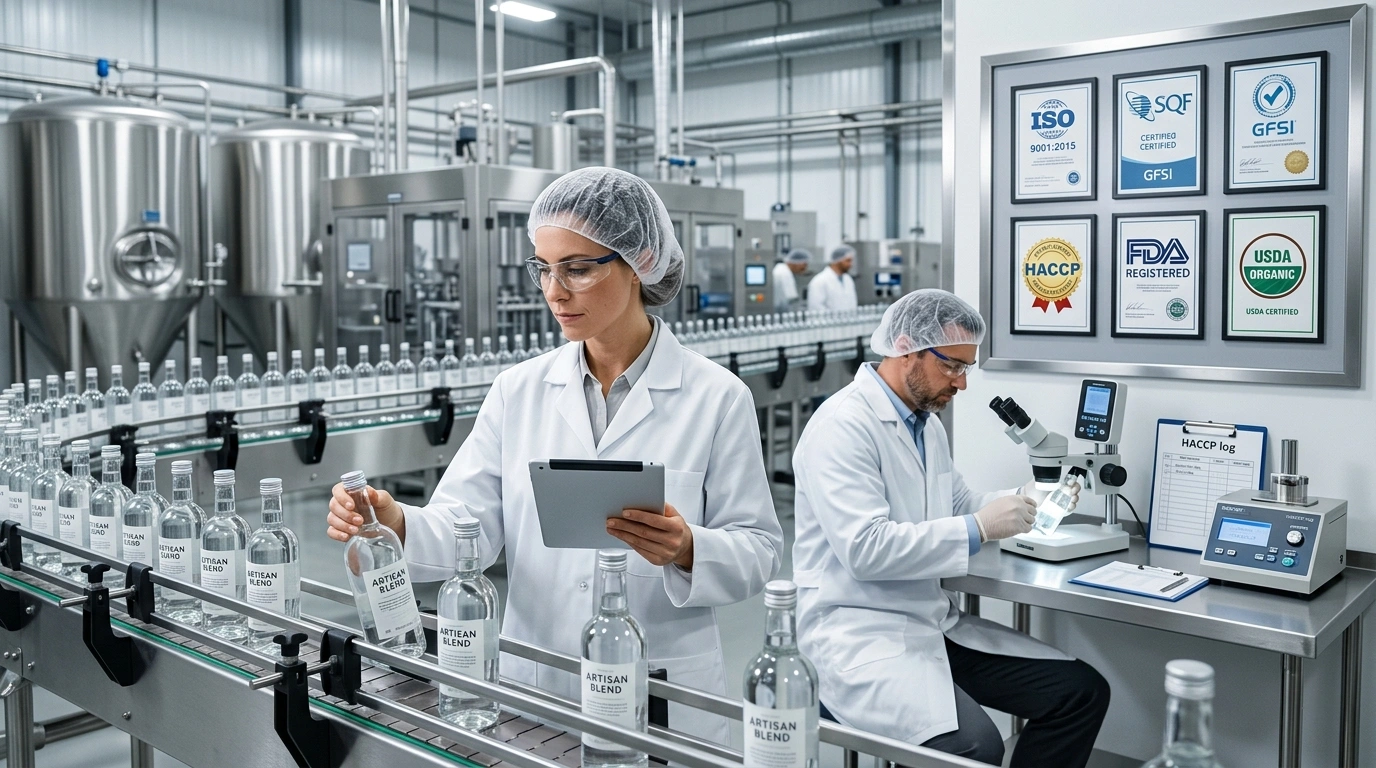
Before you sign on with any production partner, there is one important issue that should come before all else: Is this facility capable of producing my product safely and legally? By knowing the right certifications to look for in a beverage manufacturer, you can safeguard yourself against compliance problems and product recalls, as well as making costly mistakes that will be impossible to fix after your product is already out there.
Certificates aren’t simply pieces of paperwork but they are evidence of compliance with food safety, hygienic and quality standards for production by the facility, batch after batch. This guide covers which certifications are important, what they confirm and why they are crucial in assessing a company involved in beverage manufacturing.
The Food Safety Compliance and Quality certification landscape in India has become more strict with the FSSAI‘s own regulatory framework. This includes its dedicated Organic Foods Regulation 2017. A baseline is set this way for any food or beverage business that’s operating legally in the country. Choose a manufacturer that meets and exceeds this baseline which is one of the clearest signals of a serious and trustworthy partner.
Certifications To Look For In A Beverage Manufacturer
This is a breakdown of the certifications that matter the most and what each one actually confirms:
Certification |
What It Verifies |
Why It Matters |
| FSSAI | Compliance with the food safety laws of India | Legally required to sell any beverage in India |
| GMP (Good Manufacturing Practices) | Consistent and hygienic production processes | Reduces risk of contamination and quality variation |
| ISO (9001 or 22000) | Quality management and food safety systems | Signals structured and internationally recognised standards |
| HACCP | Hazard analysis and critical control points | Identifies and controls food safety risks at each production stage |
| USDA Organic or NPOP | Organic ingredient sourcing and processing | Essential if you’re marketing your beverage as organic |
| AYUSH | Compliance for Ayurvedic or herbal formulations | Required for wellness and functional beverages with herbal ingredients |
| FDA or Export Certification | Compliance with international food safety standards | Necessary if you plan to export your beverage |
FSSAI: The Non-Negotiable Baseline
No beverage without FSSAI approval can be legally marketed in India. The FSSAI certification ensures everything from the ingredients used to the proper labelling of the products and any producer that doesn’t have such certification must raise a red flag. Make sure to check the current FSSAI certificate number issued by the manufacturer.
GMP: Quality Is Guaranteed at All Times
The GMP certification proves that a plant produces products according to set standards and hygienic conditions each time, and not only when it is convenient for them. For beverages, consistency in manufacturing process, especially mixing, filling, and sanitation procedures is of crucial importance, because it may influence taste, quality or even shelf-life of the product. A GMP-certified facility usually has automated manufacturing facilities and strict quality control processes.
ISO Certification: Structured Quality Management
Certified ISO manufacturers, which include ISO 9001 and ISO 22000 for food safety management respectively, show that the process is well documented, auditable and based on continuous improvement. And this is not just certification, but a sign of operational excellence that will ensure that each batch of your product is uniform.
HACCP – Preventive Risk Management
Unlike other certification systems which evaluate the quality of the product after its production, HACCP is aimed at analyzing all potential risks at any stage of the production process starting from the source of the raw materials to packaging. This system is especially useful for beverage categories with high microbiological safety requirements, like functional drinks, juices or drinks.
Organic Certification: Essential for Organic Claims
For your beverage brand to be marketed as organic, the manufacturing plant should be certified according to standards such as USDA Organic, EU Organic and even India’s own NPOP framework. Failing to get such a certification to make an organic claim is misleading and highly non-compliant.
AYUSH: Relevant for Herbal and Wellness Beverages
If the beverage is made on the basis of Ayurvedic ingredients, adaptogenic and herbal formulations, then its AYUSH certification shows that the product complies with India’s regulations in the field of traditional and wellness-based formulations. This is an increasingly important certification as the functional beverage category grows.
FDA and Export Certification: A Must for International Ambitions
When intending to export out of India, it is important that the manufacturer has appropriate certifications and complies with destination market food safety standards, such as US FDA registration for exporting into America. This is usually an important step to undertake before formulating products.
How to Verify These Certifications?
It’s always best not to take anything at face value but rather ask for current certificates, license numbers and third party audits wherever possible. A transparent contract manufacturing will have nothing to hide from you because it is all part of their process and it goes hand-in-hand with protecting their reputation along with yours.
Conclusion
Choosing the right certifications to look for in a beverage manufacturer matters. Look for FSSAI, GMP, ISO, HACCP, organic certification wherever applicable, AYUSH certification for herbal based products and export certifications if you’re looking to go global. This is probably the most important step in the process of establishing a beverage brand. These certifications are not only required as per regulations but they build the very basics of your brand’s credibility.
FAQs
Q – What certifications should I look for in a beverage manufacturer?
A – The first step would be to make sure that the manufacturer is compliant with FSSAI, GMP and ISO standards. If it applies to your product, HACCP, organic standards, AYUSH standards and export standards could also apply.
Q – Is FSSAI certification mandatory for all beverage manufacturers in India?
A – Yes. For any beverage to be sold in India legally, the beverage producer must have an FSSAI license.
Q – Why does GMP certification matter for beverage production?
A – GMP certification guarantees the consistent manufacture of beverages through the use of hygienic production processes, which guarantees safety of the product.
Q – Do I need to obtain organic certification if I plan to sell the beverage as organic?
A – Yes. Selling the product without proper organic certification from the USDA Organic, EU Organic, and NPOP Organic (in case of India) could lead to non-compliance issues.
Q – How can I check the certifications of the manufacturers before finalizing an agreement?
A – You can ask the manufacturer to provide certificates along with their license number and third party audits.


