For beverage brands, achieving a longer shelf life does not simply involve adding preservatives. It actually involves maintaining the product’s taste, smell, colour, nutrition and texture as well as safety through storage and distribution. The question of how to extend beverage shelf life without compromising product quality involves a number of considerations including formula, processing, packaging, storage and quality testing. Manufacturers can develop shelf-stable beverages that remain safe and appealing while meeting consumer expectations when these elements work together.
Beverage Shelf-Life: Key Facts And Statistics
The U.S. Food and Drug Administration (FDA) identifies pH, water activity, emperature, preservatives and processing conditions as some important factors in controlling microbial growth. The FDA also states that most of the foods have a water activity of more than 0.95, which facilitates the growth of bacteria, yeasts and moulds.
According to FDA guidance for some pre-packaged products, the critical factor which prevents the growth of Listeria monocytogenes is when the pH is 4.4 or lower. But since beverages require a comprehensive approach for safety, specific requirements need to be determined for each individual product.
How to Extend Beverage Shelf Life Without Compromising Product Quality?
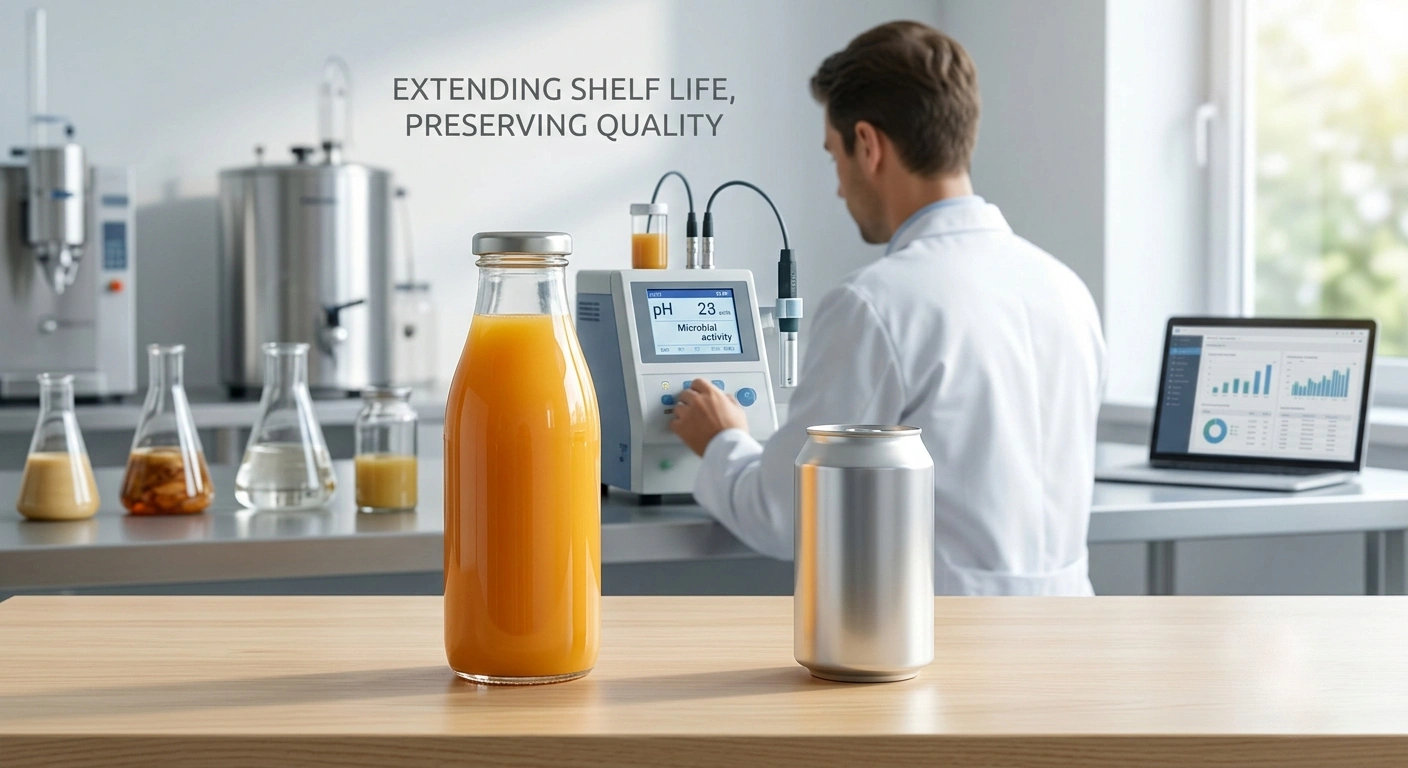
Start With the Right Beverage Formulation
Proper shelf life starts at the product development stage. The components used affect stability from microbes, oxidation, flavour retention, colour, sedimentation and overall sensory quality.
As an illustration, acidity can be manipulated in order to develop an environment that can inhibit the growth of some microbes. Water activity and microbial stability can be affected by sugar, salts, acids and approved preservatives. Changing these factors can affect taste and consumer acceptance.
That is why beverage preservation should consider the complete formulation and not an individual component. Manufacturers should evaluate pH levels, water activity if there is any, ingredient compatibility, microbial risks and anticipated storage conditions prior to completing the formula.
Use Appropriate Thermal Processing
Heat processing is one of the established methods for controlling microorganisms in beverages. It depends on the type of beverage whether pasteurisation, hot filling or a more intensive form of thermal processing is used.
Choosing the right type of processing depends on many factors like formulation, acidity, packaging, filling system, desired shelf-life and microbiological safety risk. Over-processing can affect a product’s taste, colour, vitamins and other quality aspects, while under-processing can pose significant safety risks.
So beverage shelf life should be established using validated processing parameters rather than simply increasing processing temperature or time.
Control Oxygen and Oxidation
Oxygen can affect beverage quality slowly even when microbial growth is controlled. Oxidation can also contribute to flavour deterioration, colour changes, nutrient losses and undesirable aromas.
Reducing unnecessary oxygen exposure during formulation, processing, filling and storage can result in product protection. Proper deaeration, proper filling conditions, suitable closures and appropriate packaging that has good barrier properties could result in improved beverage quality.
Antioxidant ingredients might come in handy in appropriate situations. The FDA categorises antioxidants as preservatives, which reduce oxidation and help maintain food quality.
Choose Packaging That Protects the Product
Packaging is a vital component of beverages’ preservation as the package becomes the protective covering between the product and its external environment.
The factors affecting beverages include light, oxygen, moisture, temperature changes and contaminants. Considering the suitable packaging based on the sensitivity of the beverage can ensure stability.
In this respect, aluminium cans are a good option for packing various beverage categories. The company Ayuray Organics produces beverages in aluminium cans and provides contract manufacturing, private labelling and co-packing services.
Evaluate the packaging choice alongside the formulation and processing method instead of treating it as an independent decision.
Consider Preservatives Carefully
Preservatives approved by the FDA can help control spoilage caused by microorganisms and extend product stability. FDA maintains a list of substances like sorbates, benzoates, ascorbic acid and many other food ingredients in the category of preservatives or preservation-related food ingredients that are used for preservation purposes.
Natural preservatives used in beverages cannot necessarily be considered superior just because they are natural. This is because their efficacy depends on concentration, beverage pH, formulation, presence of microorganisms, storage conditions and interactions with other ingredients.
The objective should be the lowest effective intervention that meets applicable safety. They should meet the quality requirements while preserving the intended sensory profile.
Maintain Strict Manufacturing Hygiene
The best-designed formula may also have a limited shelf-life due to contamination during the process of manufacturing. Proper manufacturing processes, clean machinery, safe water, controlled personnel procedures, and proper environmental conditions are a must.
FDA states that some of the control factors for ensuring product safety may be temperature, time, pH, moisture activity, preservatives, etc.
A robust quality system should therefore monitor critical points from raw-material handling for beverage manufacturers. This is through filling, sealing, storage and distribution.
Validate Shelf Life Through Testing
Do not make any predictions regarding shelf life based on formulation theory alone. The shelf-life test should determine what happens to the beverage under storage conditions.
Tests can include microbiological analysis, pH, sensory tests, colour, flavour, package integrity, oxidation, or any nutritional or physicochemical parameters which apply to the product.
In some cases, challenge studies may also be needed where microbial stability of the product needs validation. The FDA states that growth tests may prove useful in determining the efficacy of control measures on different food types.
Conclusion
Learning how to extend beverage shelf life without compromising product quality involves an integrated approach. Formulation, pH management, processing, oxygen management, packaging, hygiene, use of preservatives, and shelf-life testing have to be done in tandem. There is no universal preservative method for all beverages.
For those who need trusted support for beverage manufacturing, partnership with an experienced manufacturing and packaging partner can be useful. Ayuray Organics offers beverage brands contract manufacturing, private labelling and smart co-packing services.
FAQs
Q – How can I extend beverage shelf life naturally?
A – The methods of naturally extending the shelf life of beverages without affecting the quality of the product depend upon the product itself. Possible methods include suitable acidity, proper processing, correct heat treatment, controlling oxygen, proper packaging, refrigeration where necessary and natural preservation systems, if allowed.
Q – Does lower pH increase beverage shelf life?
A – Reducing pH may limit the development of some microorganisms, but it doesn’t necessarily mean that the safety and shelf life of a particular beverage are guaranteed. It is important to consider all factors like the final product, process, packaging and storage conditions at the same time.
Q – Do preservatives affect beverage quality?
A – Proper selection and utilisation of preservatives help enhance the preservation of beverages. Improper use of preservatives can influence the taste of beverages.
Q – What packaging is best for shelf-stable beverages?
A – It all depends on the formulation of the beverage, the process used, sensitivity to light and oxygen, distribution methods and required shelf-life. Aluminium cans may be appropriate for many beverage uses depending on proper evaluation of the whole packaging system.
Q – How is beverage shelf life determined?
A – Shelf life testing assesses changes in safety and quality over time in a controlled environment. The test should accurately simulate the real-life situation of the product.
Q – Why is professional beverage manufacturing important?
A – Professional manufacturing plays an important role in the integration of formulation, hygienic processing, quality control, packaging and consistency of production. All of these affect the longevity of beverages and their quality.


