
You open a fresh bottle. Looks good. Then, at the bottom, a layer of sludge. Not good. Your customer notices. Quickly.
Here’s a guide on how to prevent sediment formation in ready-to-drink beverages, and the different kinds of sediment you might see.
What Is Sediment, Really?
Small solids that settle. They’d been floating around in the drink from day one. And then, over time, gravity does its thing.
Sometimes it’s powder (cocoa, juice, minerals), sometimes it’s pulp (fruit, veg), sometimes protein or fibre, sometimes plain old salts coming out of the water.
Is Sediment Dangerous?
Not always. Often, it’s just unsightly. But the thing is: consumers don’t know that. They see the sludge and think, “Spoiled.” And they put the bottle down. Maybe they will never buy from you again.
So the goal is not just good taste. The goal is: looking the same on day 1 as day 180.
The Usual Sediment Suspects
Every bad bottle has a story. Here are the usual suspects, what to look out for, and how to solve.
| Suspect | What It Does | Giveaway Sign | The Solution |
| Heavy powders (cocoa, protein, minerals) | Too heavy to float, so it sinks | Rings at the bottom; looks thin from top | Add a stabiliser, grind fine |
| Large solids | Sinks to the bottom faster than tiny ones do | Gritty mouthfeel | Homogenise, filter |
| Hard water | Calcium and magnesium interact with other stuff in the water | White sludgy flakes | Treat or soften the water |
| Wrong pH | Protein form clumps when the pH is off | Curdled, stringy bites | Adjust pH before heating |
| Too Much Heat | Cook proteins and juice solids | Brown or granulated sludge | Control time and temperature |
| Cold Storage | Some ingredients drop out when cooled | White haze shows up in the fridge | Test in cold; choose ingredients that stay |
| Old Ingredients | Natural compounds loosely join together over time | Sediment builds up over time | Use fresh, filtered ingredients |
All of these are generally multiple small issues adding up. That’s why a drink can slip through validation on the factory floor and fail in a bottle shop.
7 Stages To Prevent Sediment Formation In Ready-to-Drink Beverages
Think of your beverage as a trip. Sediment can show up at any stop. Take care of each one and the whole trip will go more smoothly.
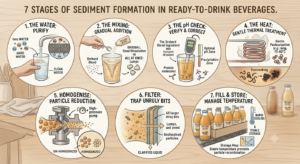
Step 1: The water
Make sure the water is as clean as it can be. You have to realise that hard water has minerals that like to react. This could lead to a few issues so you might want to have the water filtered or softened. Mundane, but necessary.
Step 2: The mixing
Add powders gradually, do not pour all at once. If you add too much at a time, then you will get lumps, which will settle out, and may cause blockages. If possible add using a high-shear mixing system to ensure every particle is coated properly.
Step 3: The pH check
Always test and measure. Correct any anomalies. Many drinks go awry here because an operator misses it. Proteins especially get their noses out of joint when the pH is off.
Step 4: The heat
Pasteurise or sterilise, but don’t overdo it. Excessive time or temperature will cook your product. And cooked solids will clump together and drop out.
Step 5: Homogenise
Homogenising is a hero. Liquid is pumped through a tiny opening at high pressure. Big particles will break down into little ones. Small particles stay up in suspension longer.
Step 6: Filter
Trapping all the stray bits and pieces, all the unruly lumps, and any bits that didn’t dissolve. It’s far better to lose them now than in your customer’s glass.
Step 7: Fill and store
Pour the bottle while hot, cool it rapidly, and preserve the drink from having wild temperature changes. The passage of stock in a warehouse or store can trigger the sediment to help shape.
Most of it is prior to the lid being placed on the container, so these aren’t doing the dirty work after.
Stabilisers: The Silent Helpers
Sometimes even the process isn’t enough. Heavy molecules want to settle. That’s their purpose in life. So you lend them a hand.
A stabiliser weaves an almost invisible network across your drink, trapping small fruit bits, minerals or oil in it. They’re now suspended in it, floating as if they were in a fruit jelly, only softer. And if you shake the bottle, it releases itself to the truest drink form of all.
A popular stabilizer is gellan gum. It’s used in ready-to-drink coffee and tea, flavoured milks, fruit juices, and soy drinks, to hold cocoa, minerals, fibre and pulp in suspension. It’s used in small quantities and can handle being heated to pasteurisation.
Fun science fact from the gellan gum patent: it doesn’t always prevent sediment from forming, but it does allow you to shake the bottle and spread the sediment back out evenly.
Other stabilising agents:
- Pectin (which naturally occurs in fruit and vegetables)
- Cellulose gum (CMC: which helps to suspend protein)
- Xanthan gum (which adds mouthfeel)
- Carrageenan (which is used in milk beverages)
Note: Increasing the stabiliser will not necessarily mean more is better. Too much stabiliser can also result in the beverage itself being very gloopy, slimy or even odd in the mouth. Use the minimum amount, trial and adjust. And of course observe any restrictions with your market.
Shelf Test: Spot it before the customer does
Don’t wait for customer feedback. Try to break your own drink first.
- Prepare a small batch of juice using the recipe exactly as you will sell.
- Use real bottles or cans. Not beakers. Presentation matters.
- Divide them. Keep a few bottles of juice at room temperature, few in the fridge, and few in a warm place.
- Check every week. Tilt the bottle up to the light. Look at the bottom. Shake it. Does it mix back?
- Smell and taste at the beginning, middle and end.
- Record everything. The date, the temperature, what you saw. There is no one way to test shelf life.
Yes, it requires patience. But a couple of weeks of regular checks will cost way less than a recall.
Want a Drink That Won’t Sink to the Bottom?
Talk to Ayuray Organics. Let’s be honest. Dealing with sediment by yourself is a grind. New recipe, new tests, new issues. And you’re still running a business. That is where Ayuray Organics can help.
We are a Chandigarh-based beverage manufacturer, and we make drinks in aluminium cans. Whether you are new to drinks or you’ve got a brand to build, you can take advantage of:
Contract manufacturing: tap into our equipment and processes without spending a bunch on your own factory
Private labelling: research, production, bottling and labelling under your label
Co-packing: packing, bottling, bundling and distribution support
Formulation and prototyping: develop a new product, then run a sample
In-house laboratory services: test your product before it gets out the door
We have ISO 9001:2015 and ISO 22000:2018, as well as FSSAI and Startup India registration. Here you will get batch testing, shelf life, formula selection and bulging cans, which all involve sediment.
If your ready-to-drink beverage is currently peering at the bottle bottom suspiciously, a conversation with our team should be your next step.
Contact us
Phone / WhatsApp: +91 7087961144
Email: ayurayindia@gmail.com
Address: SCO 859, NAC Manimajra, Chandigarh 160101
Last Sip
Sediment doesn’t usually appear as a single issue. There are a number of small problems, like water, mixing, pH, heat, pressure, a bit of stabiliser, a good filter and storage.Pay attention to these and you will have no trouble beating this problem. Resolve these and your drink will be clarified and silky smooth until the end. So put your beverage through tests, early and often, to gain the confidence of the customers in your product.
Frequently Asked Questions
Is sediment in a drink bad?
Not always. Or maybe it is simply settled powder, pulp, or minerals. But it is not very attractive and consumers may be led to believe that their drink has been spoiled. Don’t drink if it is sour smelling, foams or if the can is bloated.
Why does sediment still happen after the drink was fine initially?
Because gravity is a slow mover. Floaters first, then fall over days or weeks. Blowing a lot of thermal energy as well as shaking in storage makes things move faster.
What is the ideal fix?
There isn’t a quick-fix here, but start with treated, clean water, blend the powders in well, adjust the pH, keep the drink cool, homogenize and filter the beverage. Almost all sediment issues are sorted at the factory.
What exactly is homogenising?
It forces your drink through a tiny slit with pressure. Your big particles get broken into smaller sizes and don’t fall out so quickly.
Is a stabiliser inevitable?
Not necessarily. A transparent beverage with no solids or pulp doesn’t need stabilising. But a fiber, cocoa, mineral, pulp or protein-rich drink always does, and very little goes a long way. Too much makes a sticky, gloopy product.
Can sediment form from hard water?
Yes. Calcium and magnesium present in the hard water can precipitate out with some other ingredients and form into flaky white deposits. Use softened or filtered water to avoid sediments.
How long do I have to keep testing a product before releasing it?
The length of time in the room, cold and warm temperatures should be the same as the shelf life you expect to promote. At least a month!


