One of the most consequential decisions that you can make as a beverage founder is getting your pricing right. If the price is too high, you lose shelf appeal, price too low and you erode your margins before you’ve even scaled. So learning how to price your beverage product for retail and quick commerce matters more than you think. This means understanding your true production cost with the markups each channel adds along with the taxes that apply before your drink ever reaches a customer.
Retail and quick commerce aren’t really priced the same way. So treating them identically is one of the most common mistakes new brands make. This blog walks you through a very practical and accurate approach to pricing across both these channels.
How to Price Your Beverage Product for Retail and Quick Commerce: Step By Step
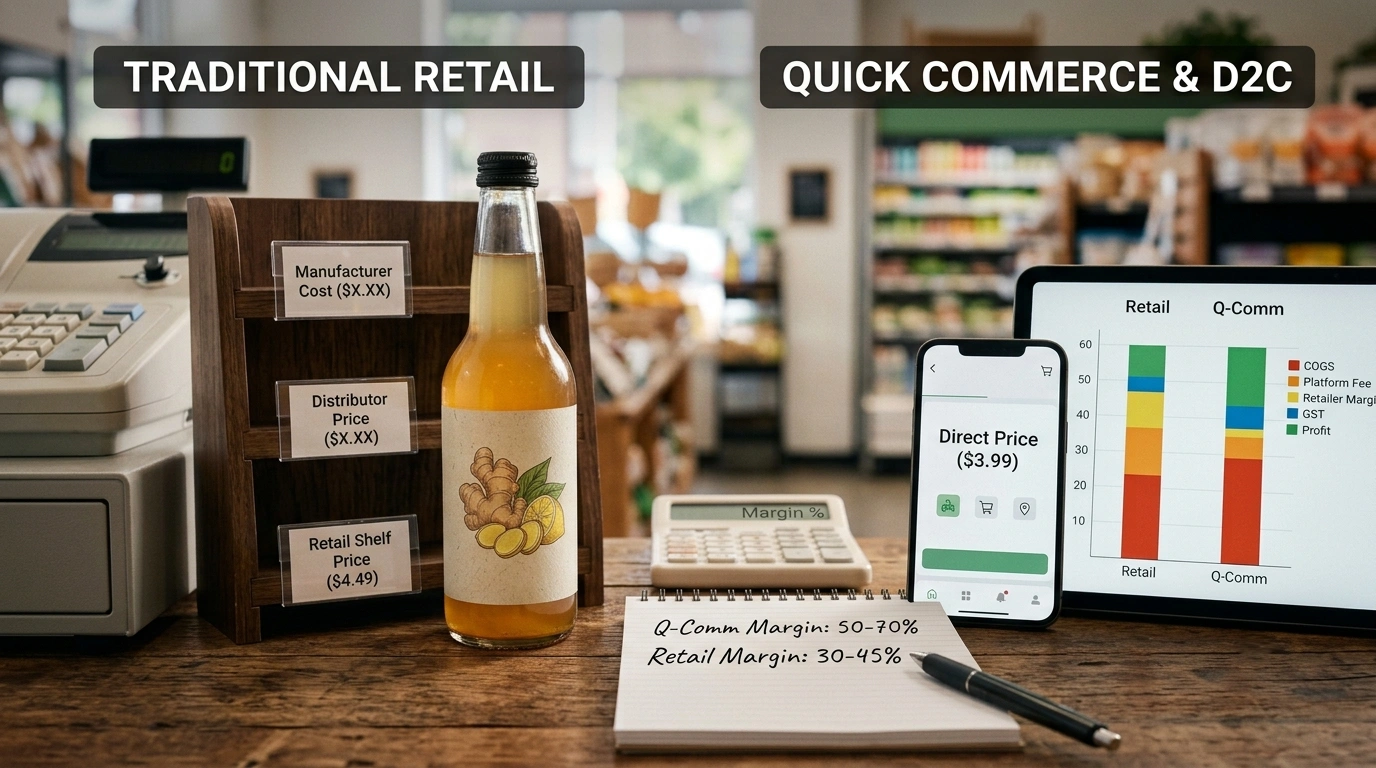
When it comes to determining prices, you begin by looking at the Cost of Goods Sold (COGS). This is the cost associated with manufacturing one unit. It includes raw materials, packaging, labour and manufacturing charges including those that you pay your contract manufacturing or co packer. The rest of the price like distributor margin, retailer margin, platform commission and GST, is built on top of this figure.
Step 1: Calculate Your True COGS
Calculate all the expenses that are involved in making a single unit of your product before you determine the shelf price. These include ingredients, cans or bottles, labels and the production charge and outbound logistics of the manufacturer. Many founders underestimate the packaging and logistics costs and they can quietly eats into margin if it’s not accounted for upfront.
Step 2: Understand Traditional Retail Margins
In traditional retail, whether general trade, modern trade or supermarket chains, your product has to go through the distributor and the retailer before going to the customer and both make their markups. Normally, brands operate on margins of 30% to 45% after distributor and retailer markup is factored in. What this means is that your shelf retail price needs enough headroom to be built in from the very beginning to accommodate this.
Step 3: Price Differently for Quick Commerce and D2C
Quick commerce platforms like Blinkit, Zepto and Instamart, along with the direct to consumer approach, follow a different economic model. Since you are closer to the end consumer with lesser intermediaries involved, the gross margin for D2C and quick commerce is usually around 50 to 70%, which means the difference between your cost of goods sold and the selling price. Quick commerce platforms also collect listing fee or commissions to keep their visibility, which should be incorporated into the price rather than being considered as marketing expense.
Step 4: Ensure Proper Consideration of GST
GST affects how you price your beverage product for retail and quick commerce and there is a huge variation based on the category of the product. According to the GST Council’s 2025 reforms, carbonated, sweetened and caffeinated beverages including most energy drinks and aerated soft drinks come into 40% GST slab. However, non carbonated fruit juices and plant milk products are subjected to GST at a very low 5%. So, there will be a huge variation in your prices based on the GST category of your formulation. You have to confirm the exact GST classification of your product before you finalise any pricing.
Step 5: Benchmark Competitors Without Undercutting Yourself
Check out similar products in your industry, but be careful about basing your prices strictly on what your competitors are charging. A newer and smaller brand usually has higher per unit COGS compared to more established players, so you could inadvertently end up eating into your margin. Price on the basis on your actual costs first before any adjusting for positioning.
Step 6: Keep Channel Pricing Consistent
Although you may have varying margins across retail and quick commerce, it is recommended that you do not price the same SKU at very different rates across the two channels. This is because doing so can erode customer trust and also make retail partners uncomfortable. Small variations to account for platform fees are actually normal but remember that large inconsistencies are not.
Why Getting This Right Matters Early
Pricing is not an aspect that you need to worry about only after a slow sales quarter. If founders take care of this issue from the very beginning, then they will not have to face the problem of having to increase prices after a while, which can upset early customers. Even discounting aggressively can affect your brand perception. Proper pricing with the help of real COGS data from your beverage manufacturer in India allows you to afford marketing campaigns.
Conclusion
Knowing how to price your beverage product for retail and quick commerce matters more than you may think. It’s about being aware of your true costs of manufacturing, how the margin structure works for each sales channel and calculating GST correctly based on your beverage category. Retail is going to leave you operating under a margin of between 30 and 45 per cent after distributor and retailer markup, whereas quick commerce and D2C have the potential to earn a gross margin of 50 to 70 per cent. This is so, provided that the platform fees are priced in from the start. All you need to do is get this right and your brand gets the financial headroom to be able to grow sustainably across both channels.
FAQs
-
How do I price my beverage product for retail and quick commerce differently?
A – For retail pricing, distributor margins and retailers need to be considered with about 30 to 45% gross margin, while in quick commerce or direct to customer model, the margins are high around 50 to 70%, however platform fees and advertisement costs should also be considered.
-
What GST rate applies to beverages in India?
A – Beverages that are carbonated, sweetened and caffeinated, which include many energy drinks, have a GST rate of 40%, post the GST reforms in 2025. Non carbonated beverages like fruit juices and plant based milk beverages are taxed at a reduced 5% GST.
-
Should I price my product the same across all channels?
A – It is advisable to make sure your price remains fairly uniform among all channels with some consideration to fees incurred by each channel, instead of having a vastly different price for the same product.
-
What’s the biggest mistake new brands make when pricing beverages?
A – Some mistakes include miscalculating the COGS, especially packaging and logistical costs. Basing prices solely on competitor pricing is also a big wrong move.
-
Does quick commerce always offer better margins than retail?
A – Quick commerce and direct to consumer sales in general generate higher gross margins than regular retail. If they’re not properly factored into the price structure, then platform fees and advertising can counteract that margin improvement.


