Launching a new beverage into the market is not an individual undertaking. For nearly all new beverages that are going to come into the market in India – be it an energy shot or an herbal RTD or any other sparkling fruit drink – deciding on choosing the right co-packer will probably be one of the most critical decisions you will make. The right co-packer speeds up your entry from the route to shelf. And the wrong one can drain your capital, compromise your quality and may even stall your launch by months.
However, most of the time the brand founders do not follow any kind of structure while deciding on this matter. Instead, they only see two things – price and MOQ. But there are many other aspects as well which can influence if the partnership can even work at scale. Here is a detailed guide for the same. This blog tells you what to evaluate and why, when you’re choosing a beverage co-packer company in India.
The Indian Beverage Market: Why Co-Packing Demand Is Growing
The beverage industry in India is growing rapidly and there is a huge demand for co-packing services in beverages.
Key Facts
- The Indian beverage market has been reported to hit USD 80.11 billion in 2025 and is expected to grow to reach USD 154.67 billion in 2035 at CAGR 6.80%.
- The ready-to-drink beverage market in India is estimated to be worth USD 8.3 billion in 2025 and forecasted to hit USD 14.1 billion in 2034.
- Regional beverages currently represent 15% of India’s carbonated beverages market.
Source: Expert Market Research | IMARC Group
For most of the startups, it’s important to partner with a beverage co-packer as it’s far more practical than investing in manufacturing infrastructure.
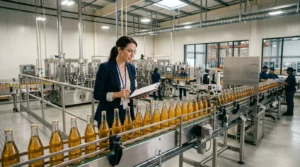
What Is a Beverage Co-Packer?
A beverage co-packer or beverage contract manufacturer is the entity that will manufacture and package the beverages under your own brand label. Even though you will have your own formulations and branding strategy, it will be the co-packer who will provide production, technical know-how, and compliance.
Some of the things included in a typical beverage co-packing service include:
- Formulations and product prototyping
- Source for raw materials
- Production and filling
- Labeling and secondary packaging
- Quality control and lab analysis
- Stock management and shipping
A full service partner can be your one-stop-shop for your beverages!
7 Critical Factors to Evaluate When Choosing a Beverage Co-Packer
Regulatory Certifications
It is essential that all FSSAI certified co-packers have an FSSAI license, but good manufacturers also keep themselves updated with internationally recognized certifications.
Here are the ones you need to look for:
- FSSAI License
- ISO 22000:2018 (Food Safety Management)
- ISO 9001:2015 (Quality Management)
- Startup India Certification
These certifications are related to consistent quality and food safety practices, which reduces your regulatory risks.
Formula Development & Prototyping Capacity
Most start-up founders come to a beverage co-packer with just an idea, not a fully developed formula. Effective formulation development capacity will save time and money for your project.
Inquire about such things as:
- Do they have their own food technologist/formulator?
- Are they able to formulate natural or organic beverages?
- How many rounds of prototypes will be produced?
- How soon after formula approval can the product go into production?
Formula development capacity is just as important as production capacity for function beverages, herbal drinks, and fortified ready-to-drinks.
Packaging Format Compatibility
Not all beverage copackers accommodate all packaging formats. Ensure that the packaging of your choice – aluminium cans, PET bottles, glass bottles, or tetra packs – is accommodated.
For the launch of canned beverages, ensure:
- Slim, sleek and regular cans
- Carbonated or nitro filling
- Shrink sleeve or print-on-can labeling
- Cartons and multi-packs
Selecting a production partner with suitable production capabilities helps retain consistency in products.
Minimum Order Quantities (MOQs) & Scalability
Whereas MOQ is an important factor, scalability takes priority above all else.
Determine if the beverage co-packer will be able to accommodate not only your current launch but also any future expansion.
Some factors to think about:
- If the MOQ fits within your launch budget
- Production capability to expand in the future
- The ability to scale up without switching manufacturers
Switching the beverage co-packer due to sudden success may cost a lot and may also compromise the quality of the product.
In-House Quality Control and Laboratory Services
A co-packing business that uses third party laboratories for all its quality testing activities will face delays, limited visibility into batches and poor root cause analysis whenever problems occur. Give preference to co-packers with in-house laboratory facilities able to do the following:
- Microbiology tests (yeast, molds, bacteria)
- Batch-wise pH and Brix testing (amount of sugar in the solution)
- Shelf life testing
- Testing for heavy metals and adulterants in herbal/natural formulations
- Label claim testing (accuracy of nutritional information according to FSSAI standards)
Having an in-house quality control laboratory facility does not only mean having better quality but is a huge timesaving feature as well. Many brands would want to get quick feedback from their partners about their products.
Ingredient Sourcing Philosophy
In case you are developing a health-centric, organic, or clean-label beverage line, the sourcing philosophy of your beverage co-packer is a component of your brand story whether you share it or not. Inquire whether:
- You value natural or organic raw materials suppliers more?
- Can you give COA for all raw materials?
- Are you in favour of ethical sourcing or regional ingredient sourcing network?
- How do you manage in case of failure of the main ingredient supplier?
Ingredient sourcing becomes an issue of brand equity when dealing with functional and wellness beverages. A co-packer which cannot provide any information regarding the source of their ingredients will be a burden on you when customers and/or buyers start asking questions.
Transparency, Communication, and Partnership Culture
The least valued but perhaps the most crucial element in selecting a beverage co-packer is their ability to communicate. A world-class facility that responds slowly, does not give timely information about production deadlines, or cannot be reached at times of a production issue can end up being very expensive than the extra cost per unit paid.
Some of the questions you may wish to ask include:
- Do they have an account manager for your brand or not?
- How do they handle any production delays and issues?
- Do they keep track of batches and production?
- Are facility visits welcome in the facility or not?
The best co-packing facilities for beverages are those that will make you feel like you own a stake in the production process.
Red Flags to Watch For When Evaluating a Beverage Co-Packer
Absence of the FSSAI license number – You have to verify it through the FSSAI Food Licensing and Registration System website
Reluctance to share COAs or quality documentation – A proper facility will always share its documentation easily with you
Unclear schedule – if a co-packer cannot provide you with approximate lead times according to the production stages, that means it’s a poor organisation
Lack of formulation help – forces you to approach the process with your formula ready, thus negating the technical partnership aspect
No internal laboratory – leads to delays and decreased control over the quality of goods
Conclusion
Choosing a Beverage Co-Packer in India is not just a process of procurement. It’s the one that has long-term implications on your brand’s quality and time to market. Start by assessing the certifications before looking at the capabilities for formulation, packaging, MOQs, internal quality control, source of ingredients, and communication practices.
We at Ayuray Organics have full-scale beverage contract manufacturing and innovative co-packing services in various forms, certified as ISO 9001:2015, ISO 22000:2018, and FSSAI. Whether it’s in-house formulation & prototyping, lab analysis, labeling and shipping or anything else, we are there to work alongside the health-oriented beverage brands in all phases of their growth process. Are you prepared to introduce your beverage brand in the market?
Frequently Asked Questions
Q1. What is the difference between a beverage co-packer and a contract manufacturer?
The beverage co-packer deals mainly with filling, packaging, and labeling while the beverage contract manufacturing firm also includes formulation and ingredient procurement. This can be provided by many companies such as Ayuray Organics.
Q2. How do I verify that a beverage co-packer is FSSAI licensed?
The verification of their license should be done through FSSAI FoSCoS Portal based on their license number or company name.
Q3. What certifications should I look for?
You should choose a FSSAI certified co-packer with ISO 22000:2018 and ISO 9001:2015 certifications. This is important to ensure that they have recognised food safety and quality management standards.
Q4. What is a common MOQ for beverage co-packing in India?
MOQ varies according to packaging format and production line capacity. Talk about the minimum order quantity with your beverage co-packing partner as per your requirements.
Q5. Can a beverage co-packer help develop my formulation?
Yes. Most of the beverage co-packers not only manufacture but also formulate drinks using natural/organic ingredients.
Q6. How long does it take to start production?
From 6 weeks to 12 weeks can be taken to transition from the approval of your formulation to production.


