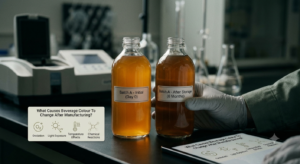
You make a drink. It is perfect in the big batch tank. You fill, pack and distribute it. A few weeks later, the same drink looks darker, lighter or just a little boring. What has happened?
Colour change is one of the most common problems in the beverage world. It might seem small, but customers notice it immediately. In this post, we show you in easy words, what causes beverage colour to change after manufacturing, how to slow it down, and how a good manufacturing partner can help.
Why Customers Care About Colour So Much
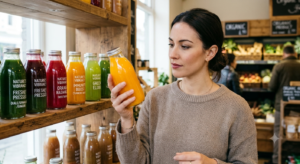
People buy with their eyes, first. Before anyone drinks a fruit juice, health shot or energy shot, they will look at it. If it is bright and consistent in colour, it looks fresh. If it is dull and/or brown, this can signal to the customer that there’s something wrong, even if it’s perfectly good to consume.
The Main Reasons For Beverage Colour Change After Manufacturing
1. Light
Light is a big colour enemy. Light can wash out natural colours from fruit and plants or added colours, and even clear glass or plastic. The way the light passes through clear glass or clear plastic allows more light through. Aluminium cans completely block out light, and so that is one reason why many drinks are put in cans.
2. Heat And Warm Storage
Heat speeds up nearly everything happening inside a drink. Bottles and cans stored on shelves in a hot shop, on a truck, in the warehouse or in a hot country like India will change their colour much faster than those stored in a cool place. In some countries, a long hot season is a real concern.
3. Oxygen
When a drink touches air, oxidation begins. The same as what turns cut apples brown. Oxygen can enter during the mixing process, the filling process or due to an imperfect seal. Over time, it can make the drinks darker or dull.
4. Ph: How Sour Or Bitter The Drink Is
Many natural colours are dependent on the pH or pH range of the drink. Some colours are stable in acidic drinks, but become dull or change colour when the pH drops or rises. Even a small change over the shelf life can lead to shifting colours.
5. Natural Colours Are Sensitive
All coloured, pigmented flowers, fruits, vegetables and roots are beautiful, but they’re quite weak, more prone to fading, darkening or colour shifts than artificially made colours. You end up with a much simpler label but at the expense of greater sensitivity. They can be moderated with good formulation and good packaging.
6. Ingredient Interactions
A quality drink can contain many ingredients, such as sugar, preservatives, acids, vitamins, minerals, plant extracts and protein. You may observe them changing in colour as time goes by. Vitamin C can cause browning. Sugar or some proteins may cause yellowing. Metals such as copper and iron in the water may cause colour shifts.
7. Heat During Processing
Sometimes the colour change begins in the factory. Pasteurisation or other heat treatments are needed for safety, but too much heat, or being held too long, can cause browning. The colour may be good after filling, but it can continue to change over time.
8. Microbes
If bacteria and moulds get into a drink because of poor hygiene or improper preservation, their growth can cause changes in the colour, cloudiness and odour. This is a serious quality issue – not just a colour or looks issue. This is the reason why clean manufacturing and proper quality control testing matter so much.
9. Packaging
Packaging is the final barrier. A pack that allows light or air into the bottle or pack will allow the colour change to happen faster. A light- and air-blocking pack like the aluminium can keeps the drink more stable for longer.
How Brands Can Slow Down Colour Change
Of course you can’t stop colour change, just slow it down. Here are some steps:
- Select stable colours that match the drink’s pH
- Keep the pH constant
- Use treated water with low metal levels
- Prevent oxygen from mixing in
- Do not overheat the drink during processing
- Choose the pack that blocks light and air
- Ship and store cool, away from light
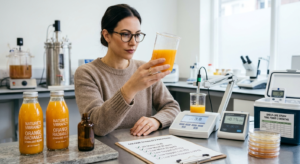
- Perform shelf-life studies to see what colour the product will have on the shelf
The last point is very important. Testing by batch and testing by shelf life will show you problems before your customers tell you.
The Demand: Why This Is Even More Critical Than Before
The ready-to-drink trend continues. Consumers are looking for portable packaged drinks to grab and go, healthy drinks, energy drinks, iced tea and wellness drinks. Consumers are reading the labels more closely. Many consumers are looking for something natural, something without a lot of colour, with ingredients they recognise.
It creates a challenge for brands. Customers want natural and clean but also want the drink to look the same after 90 days. Achieving both requires the right formulation, the right testing and the right packaging. Those brands that achieve this gain trust and repeat customers. Those that don’t often end up with returns and poor reviews.
As markets grow more crowded, small differentiating factors like colour stability can make the difference between a product left on the shelf and one being pushed by sales staff.
Making Your Beverage With Ayuray Organics
You might not need to figure all of this out on your own if you’re looking to develop or expand a beverage brand. Ayuray Organics is a beverage manufacturing company that specialises in beverages in cans and is located in India. With ISO 9001:2015 and ISO 22000:2018 certifications, quality and safety are a priority at Ayuray.
Here’s how Ayuray Organics can assist:
Contract Manufacturing: Have your beverage produced more quickly, inexpensively and with the latest technology, all while avoiding investment in a plant of your own.
Private Labelling: We can produce drinks for you that you can sell under your own label. The team will make your formulation, produce and label your drink, ready for you to place on the shelf.
Smart Co-Packing: Flexible & scalable packaging support – from assembly to labelling, bundling and distribution.
In-house Laboratory Services: Supporting testing to ensure stability and quality.
Product Formulation and Prototyping: Creating a formula that looks, tastes and stays great.
Aluminium cans won’t let in light, so your drink will stay full of colour and flavour. When used in conjunction with sampling and formulation, this will give you a better chance of a good-looking drink in your customer’s hand.
Ready to start your beverage brand?
Website: ayurayorganics.com
Phone / WhatsApp: +91 7087961144
Email: ayurayindia@gmail.com
Location: S.C.O 859, NAC – Manimajra, Chandigarh 160101
Conclusion
When a drink undergoes colour change during post-production, there are a host of reasons: light, heat, oxygen, pH, softer natural colours, ingredient reactions, processing heat, microbial growth, packaging, you name it. Yep. We have the know-how to control most of these: through the formulation, aseptic manufacture, smart packaging and testing.
If you want a beverage that will be fresh every day, consider colour from the beginning, not when you’ve got a problem. And with the right manufacturing partner, Ayuray Organics, you’ll have a lot of wise advice along the way.
Frequently Asked Questions
Why does my beverage darken?
Most common is oxygen, heat and reacting ingredients. Oxidation and browning reactions occur gradually, and your beverage will grow darker over time.
How come my drink loses the colour?
It’s mostly the effects of light or heat. Natural colours have a tendency to lose their colour when in contact with sunlight or in a warm room.
Is a drink safe if its colour has changed?
Not necessarily. Most of the colour changes are only in appearance. However, if the colour change is accompanied by a bad odour, a peculiar taste, visible cloudiness or swelling of the package, do not consume it.
Are natural colours less stable than synthetic colours?
Yes. Natural colours are generally more delicate, more susceptible to light, heat and pH variations than synthetic colours, but with the right formulation and packaging, they are very stable.
How does packaging influence the colour of a drink?
Bright bottles let in light and usually air too. Aluminium cans are light-proof and create a hermetic seal that helps preserve colour stability.
What’s the effect of pH on colour?
Most colours shine at their best within a certain area of acidity/alkalinity. Deviate outside this area, and the colour can become washed out or change colour altogether.
Can the change in colour be prevented?
No. But it is possible to greatly limit the effect by low oxygen, low heat, light protection, and some chill storage.
How do I test for colour stability before I launch?
Do shelf-life and batch testing. Keep some samples in various conditions and observe colour change over a period of time. An in-house laboratory at your producer can assist you.
Can Ayuray Organics help me develop a balanced, visually appealing product?
Yes. Ayuray Organics provides contract manufacturing, private labelling, co-packing, formulation assistance and lab testing for beverage brands.


