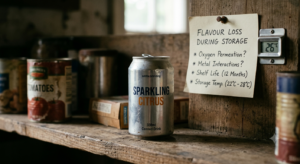
Have you ever experienced a drink that was good in its can but tasted quite different after a few months? The time lapse between the canning of a beverage and the first gulp is where the brand wins customers or loses them. At Ayuray Organics, we brew beverages in aluminium cans at our unit based in Chandigarh. The first few things we always look into are flavour stability, when it comes to brewing from a formula to shelf of a brand.
The best part here is that the flavour loss in canned drinks is quite predictable. It can be attributed to only a few causes, and most of them can be minimised with wiser choices of formulae, filling and storage. Here is what exactly happens inside a can.
-
Oxygen: The Most Common Flavour Thief
In most cases, the presence of oxygen is the reason for the flavour loss in canned drinks. Even a minimal amount of oxygen, dissolved in the beverage at the time of canning or present in the headspace of the can, interacts slowly with the flavour compounds. This is widely seen in beer, and that stale, cardboard-like flavour is obtained. In the case of other beverages, the aroma diminishes, the top notes flatten, and the beverage tastes duller or flat.
Thankfully, oxygen in a can doesn’t do much if the can is sealed, so the oxygen that we need to have a significant effect is the oxygen in the can at the point of canning. The ingredients handling, filling and seaming steps are just as relevant as the can itself when it comes to oxygen management.
-
Heat: The Reaction Accelerator
Heat catalyses nearly every chemical reaction, and flavour change is one among the many others. The warmer the storage, the faster the oxidation and other non-oxidative ageing processes occur; this often results in cooked caramel or honey-like flavour notes that may not be present in the original product. For instance, studies in brewing have demonstrated that ageing compounds build up more rapidly at 30°C.
For Indian brands, this is an important consideration. A warehouse without an air conditioner, a car standing in a parking lot all day, a shelf in the sun through the summer can cause a complete shift in flavours in just a few weeks. Every week of storage at higher temperatures reduces the shelf life of a product by more than a few days.
-
Light: A Problem Before the Can Is Sealed
Light can cause the breakdown of colourants, aroma compounds and vitamins. However, since aluminium blocks out the light completely, this is an advantage over glass and plastics. Once a beverage is canned, it no longer comes under the influence of light.
However, the risk occurs before the beverage is sealed in a can. Raw materials, ingredients, oils and extracts can get affected by light even before the can is filled. So, if you want to extend the shelf life of the formula, the entire production process and chain need to be taken into account.
-
Formula Chemistry: The Metals, pH, and Delicate Flavours
The contents of a can influence its shelf life to a large extent. There are three things that affect the stability and shelf life of a formula.
Metals: Iron and copper in water or ingredients can act as catalysts in speeding up oxidation.
pH levels: Studies in beers have shown that lower pH can accelerate some staling reactions, and acidic beverages put greater demands on the internal lining of a can, which keeps the beverage separated from the bare metal, preventing the metallic taste.
Delicate natural flavours: Plant-based, citrus or herbal beverages can rely on volatile aromas, making them susceptible to any changes in storage conditions.
The good news is that natural formulae can easily work in cans without any issues. It only means that they need to be designed with an emphasis on longevity from the outset.
-
Flavour Scalping: The Line of The Can Liner
Since cans have a liner on the interior, some of the aroma compounds can be absorbed and scaled into the lining material. Low-affinity for water, hydrophobic, oily compounds, such as terpenes, show this phenomenon more than others. One study in beer actually reports transfer of hop terpenes into packaging materials, and can liners are no exception, which eventually makes the packaged beer taste different from what it was initially.
The nature of the change is vastly dependent on the type of beverage. In one study, one style of beer experienced a perceptible shift while the other barely showed any difference. It also reported that liners of a can absorbed less aroma than the cap liners of a bottle, and hence, this might be a lesser concern. Nonetheless, it still exists in actuality and is yet another reason to test for flavour stability in the final package.
-
Time: Flavour Is Always Moving
All of the above factors are running simultaneously in a can. The flavours are always going through changes, regardless of conditions being favourable or not. The design goal is to minimise that change so that beverages reach consumers and beyond, with a taste that is as close to the original as possible.
Protect Flavour from ‘Day Zero ‘: How We Make Flavour Last
We plan for flavour stability from day zero, not plan for it! As a beverage manufacturer, we partner with entrepreneurs and legacy companies to support brands in:
Formula and prototype development: We help perfect recipes so ingredient selection, balance and acidity are in harmony with canning.
Our in-house laboratory for sample comparisons: Test and trial with no guesswork.
Contract manufacturing, private labelling and co-packing: Can filling and canning with quality assurance in a controlled environment, so you don’t need your own plant.
Certified quality systems: We are ISO 9001:2015, ISO 22000:2018 and FSSAI certified.
We strongly recommend the most humble shelf-life tests. Keeping canned samples at different temperatures and tasting them against a freshly canned sample can quickly tell you how a particular recipe will behave. Thus flavour loss in canned drinks can be avoided.
Storage Advice for Brands, Distributors and Retailers
Even the best can of beverage needs to be stored sensibly to limit flavour change and degradation:
- Store cans cool and dry. Keep cans away from direct sunlight.
- Don’t leave stock in parked vehicles or uncooled warehouse space during the hot months.
- Use older stock first, so no batch remains shelved longer than necessary.
- Keep cans undented, as rough handling can damage seams and can linings.
- Serve drinks chilled; cold storage minimises flavour change.
How To Make a Canned Beverage Taste Identical on Day One and Day Ninety
The promise we are making to your customers – and we’re committed to honouring it. Whether it’s a new canned beverage that you’re about to launch, or an existing one you want to make last the distance, we’re happy to chat. Contact us at Ayuray Organics to talk about formulation, testing and canning your brand.
Contact Details
Contact: +91 7087961144
Email: ayurayindia@gmail.com
Address: SCO 859, NAC Manimajra, Chandigarh 160101
Conclusion
Flavour loss in canned drinks isn’t from just one cause. They will, however, lose it from a combination of oxygen in the can after filling, time, warm storage, trace metals in ingredients, absorption into the can coating, the level of acidity and – in the case of value drinks – the economics of possibly sacrificing a little more of the drink to maintain an adequate flavour profile. The good news is that it’s all fixable.
And for a beverage brand, that’s the magic that makes a one-time customer a lifetime customer. And for Ayuray Organics, we built the shelf-stability into our process from first prototype to finished can so that whatever you open up is what the brand set out to make.
Frequently Asked Questions
Does a can taste better than a bottle?
A can is the best way of protecting your drink from light and oxygen, so it is better in many cases. The beer research has varied and there is no winner in all drinks of the bottle or can. That is why we do shelf-life testing of the formulas in the packaging.
Can you prevent loss of flavours?
No. Only slow down with the right formulation, filling, and storage. There are inevitable changes.
Does high temperature influence flavour?
Yes, very much. Higher temperatures speed up oxidation and the ageing process of the drink.
Does under-scaling influence flavour?
Not only that, but bottoming out the can. We can answer this question if we know the formula, the fill, the lining and how long the product has been since filling.
How long can a can last?
Depends on the formula; shelf-life testing is the most appropriate way to find out, and we are happy to perform this test!
Will scratching a can influence taste?
Possibly; often, dents and rough handling damage the can and put stress on the seams and the lining. This can allow oxygen in the can and deteriorate the lining. We recommend setting aside any damaged cans!
Can hot storage influence taste?
Yes, it does. We always recommend keeping the cans cool in order to prolong their shelf life! Save the cans in the can cooling before putting them in the fridge.
Can Ayuray Organics advise on a can launch?
Yes. Feel free to contact us for advice on recipes, prototype development, in-house shelf-life testing, private labelling or co-packing.


