You may have seen the booming beverage industry of India. You can’t miss the functional drinks and herbal infusions. Ready to drink juices as well as wellness tonics have changed the game. You may notice new brands entering the market every year. In this growth, one question comes up again and again. Beverage enterpreneuras and established players are thinking one thing. Should you manufacture beverages in house or opt for contract manufacturing?
Now there’s no universal answer for this. The right approach depends on your business goals actually. Your scale, investment capacity changes it all. How quickly you want to reach the market matters.
India’s Beverage Market at a Glance
Did you know about India being one of the fastest growing beverage markets? You should be aware that urbanisation and rising health awareness are behind it. Changing consumption habits has done a lot here.
If you look at the recent industry research, the Indian non alcoholic beverage market is booming. It had a value of about USD 32.06 billion in 2024, which is a big thing. By 2033, it is projected to reach USD 68.73 billion. This shows a CAGR of about 8.16 % over that period. Source: IMARC
This growth shows a stong demand across segments. These include bottled water RTD teas and coffees. This is as consumers now focus on hydration, wellness benefits more and more.
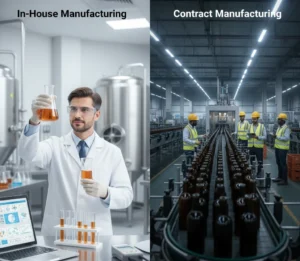
What Is In-House Beverage Manufacturing?
You own and operate your own beverage production facility for in-house manufacturing. This means you are the one whose supervision lets everything happen. Tasks like sourcing raw materials happen under your direct supervision. This means processing to bottling, packaging, and quality checks.
Why Brands Choose In-House Manufacturing
Complete control over quality and formulation
It is perfect for those brands with proprietary recipes. It works well with complex formulations which is what many brands look for.
Custom production processes
You can fine tune every step to match your brand philosophy.
Long term cost efficiency at scale
Brands know per unit production costs can go down once the volume increases.
Challenges To Consider
High capital investment – Machinery, infrastructure, and manpower
Longer setup time – Regulatory approvals and compliance
Operational complexity – Especially for startups or lean teams
This type of manufacturing best suits brands who have large demand. So choose this if you have predictable demand and long term production plans.
What Is Contract Beverage Manufacturing?
Basically, contract manufacturing is all about outsourcing beverage production. That is done by a specialised manufacturing partner.These are the facilities that have it all, infrastructure, certifications and technical expertise. This is where you manufacture beverages at scale. This is how you focus on brand building, distribution, and marketing. And you don’t have to worry about production as that is handled by experts.
Why Contract Manufacturing Is Gaining Popularity in India
Lower upfront investment
So, there’s really no need to spend heavily on plant setup and machinery.
Faster time to market
This is perfect for new product launches or even pilot batches.
Scalable production volumes
Based on demand, this is where it easily ramps up or scales down.
Regulatory readiness
Established manufacturers mostly operate FSSAI compliant facilities.
What Are Some Things to Be Mindful Of?
- Less direct control over day-to-day production
- Clear agreements required to protect formulations and IP
- Dependence on partner timelines during peak seasons
If you are an Indian beverage brand, then think about contract manufacturing. It could be a smart entry point for you, especially in fast moving categories.
In-House vs Contract Manufacturing: A Practical Comparison
| Factor | In House Manufacturing | Contrast Manufacturing |
| Initial Investment | High | Low |
| Speed to Market | Slower | Faster |
| Quality Control | Full Internal Control | Shared responsibility |
| Scalability | Limuted by capacity | High Flexible |
| Operational Load | High | Minimal |
| Best For | Large scale, mature brands | Startups & growing brands |
Is a Hybrid Model the Future?
There are many successful beverage brands that stick to just one approach.
A hybrid manufacturing model changes everything here. This is where core products are made in house. But the new and seasoned SKUs are outsourced. This is where you get flexibility without compromising control. This approach is becoming more and more common in India. The functional beverage segments are the ones that have changed the game.
Conclusion
It’s not actually about which is better when you choose between in house beverage manufacturing and contract manufacturing. It’s about what works right now for your brand. And where you want to go next.
Is speed and low risk what you focus on? Then contract manufacturing is the right choice to launch it. But if you focus on long ter control and large volumes, this is not it. You should then be choosing in house manufacturing which would be worth it. In India’s fast moving beverage market, all you need is quality, compliance, cost and growth potential. So make the right and smart decisions.
Frequently Asked Questions
Q – What’s the difference between in house and contract beverage manufacturing?
A – In house manufacturing is where you product beverages in your own facility. But contract manufacturing is where you outsource production to a third party manufacturer.
Q – Is contract manufacturing suitable for beverage startups in India?
A – Yes, contract manufacturing is mostly chosen the most by startups actually. That is because it reduces capital investment and allows quicker market entry.
Q – Does contract manufacturing affect product quality?
A – The quality really just depends on the manufacturing partner.
Q – When does in-house manufacturing make more sense?
A – In house production is when brands have high volumes. Also consider it if you brand has proprietary formulations, and long term production plans.
Q – Can brands scale faster with contract manufacturing?
A – Yes, contract manufacturing does allow flexible production volumes. This makes it easier to respond to changing market demand.
Q – Is FSSAI compliance easier with contract manufacturing?
A – You may notice that most contract manufactures in fact have compliance facilities. This can simplify the regulatory process for your beverage brand.