
Everyone likes a beverage, have you wondered how these beverage manufacturers handle allergen control? In the field of beverage manufacturing safety is the silent but the most important ingredient that defines a brand’s success.
Wonder why Allergen Control is necessary?
It’s for those who are living with serious food allergies because there is no such thing as a minor error. Think of that if the people with food allergies take even a tiny amount of undeclared protein then this can turn a simple digestive upset into a life threatening emergency in seconds.
That’s why At Ayuray Organics, to become the perfect in the art of clean, safe, and transparent liquid production we have spent over 15 years. So that we transfer the quality driven beverages by working on every aspect.
In this article, we will talk about how beverage manufacturer brands protect their consumer and their reputation.
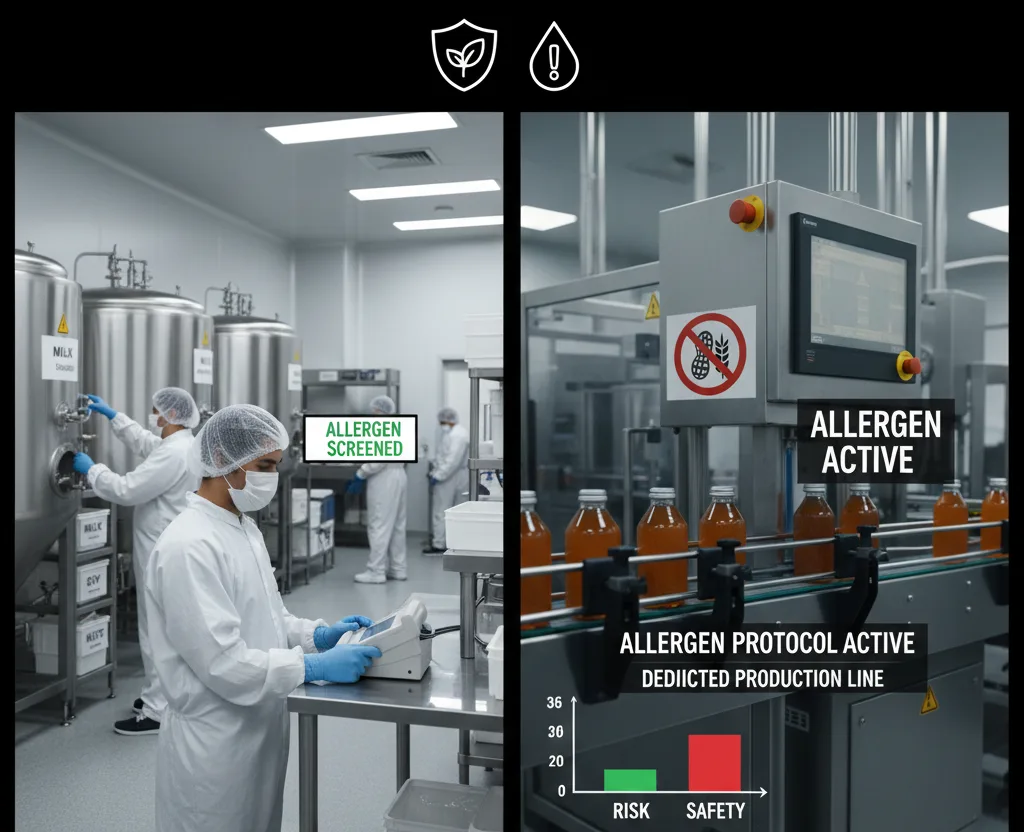
3 Pillar of Prevention: The Allergen Control Plan (ACP)
When it comes to building a strong brand name in the beverage industry, there is no holding back in terms of the quality and mistakes. So an effective Allergen Control Plan isn’t about something to write and forget, it needs to be used and updated regularly according to research and situation.
For better understanding of these 3 pillars of prevention we provide these pillars with explanation.
Let’s start,
Ingredient Architecture and Storage:
It is important to get the allergen control over ingredients as soon as it arrives at your facility. So that ingredient with allergens must be treated as a high risk item as soon as from the moment it is received and checked.
- Dedicated Zones: Arranging them to their zones according to their safety is important. Like soy, tree nuts, or dairy are needed to be stored in specifically designated areas and any allergen ingredients should be never above free from allergens.
- Visual Cues: For the quick safety process, it’s important to put clear and bright color labels on every container so that the workers can get the idea of what’s inside by just looking at it. Because in a busy workplace the chances of mixing boxes are higher, to prevent these mistakes these visual signals act like an alert system.
Intelligent Production Scheduling
This just one tool is the most effective and simple tool in our arsenal which is Production Sequence. In this tool, we always made the products first which are without allergen.
So that in the making process only allergen free items were made. And this will decrease the chances of mixing allergen free ingredients with allergen ingredients.
- The Clean to Dirty Flow: We dramatically decrease the chances of mix with allergen by just manufacturing the most sensitive products at the start of week.
- Logical Transitioning: We use simple logic, by manufacturing the items first which are allergens free. The only foods with allergens left and we made these items after manufacturing allergen free items.
The Science of Sanitation (CIP Systems)
As you know, in the beverage company production their pipes and tanks are often closed systems. So, ignoring these sealed systems may cause many problems for your product quality, and brand reputation. To get rid of this we use an automated cleaning method which is called Clean In Place. It makes sure everything is clean and safe by pumping water, heat, and cleaning chemicals.
- Mechanical Force: By using mechanical force which means a high pressure spray, balls help to clean the inside of stainless steel tanks very well by spraying the cleaning fluid. As a result, nothing stays stuck in the tanks.
- Validation: Relying on just machines, doesn’t mean it worked. We need to verify from ourselves because we don’t just trust the machine. For that we use the ELISA (Enzyme Linked Immunosorbent Assay) test’. We swab surfaces and test the final cleaning water to make sure allergen proteins are completely gone.
Labeling: The Final Safeguard
Over the 15 years of experience in the beverage industry, Ayuray Organics have taught us that the packaging line is also important for the brand reputation as critical as the mixing tank. What we learn from over the period in the industry is that most food recalls happen not by cleaning failure but by mismatched labels.
- Barcode Verification: Its simple and effective ways to decrease the chances of mistakes. It simply means checking the label on the bottle is the correct one for filler.
- Label Reconciliation: The effectiveness we found in this is super, counting every label we printed and every label we actually used. By doing so we could cause serious mix ups.
Conclusion
To have control over the allergen, you have to be careful sourcing of ingredients. Manufacture allergen free items first so that you have the full focus on allergen ingredients. In this process don’t ignore the strong cleaning process and also take care of ingredients by correct labeling. All of these play an important role in building trust with consumers and help to increase the brand reputation.
FAQs about How Beverage manufacturers Handle Allergen Control
Q) What are the Big 9 allergens in the beverage industry?
A – These Big 9 allergens cause serious allergic reactions
- Milk
- Eggs
- Fish
- Crustacean shellfish
- Tree nuts
- Peanuts
- Wheat
- Soybeans
- Sasame
By knowing these allergens, manufacturers label drinks correctly so that people with any food allergies can be safe.
Q) Is Gluten- free the same as allergen-free?
A – Not completely, Gluten-free is treated differently from regular allergens. But when we talk about cleaning and testing steps. They are very similar to allergen control.
Q) Can a manufacturer use the same equipment for nut milks and water?
A – They can be used but only if they have a strong valid Allergen Control Plan.
Q) What is the May Contain label for?
A – It simply means even after best cleaning efforts. There is no 100% guarantee of safety and any allergies can occur.
Q) How often are staff trained on allergen protocols?
A – For the handling of allergens all staff are trained regularly because ignoring these can lead to higher mistakes. Whenever new employees join, they get training when they start and also everyone gets refresher training at least once a year.


